
'/%3E%3C/svg%3E)


'/%3E%3Cpath%20fill='%23b2b2b2'%20d='M241%20382q0%2016%2017%2026%2017%2011%2042%2011t42-11q16-11%2017-26V269H241'/%3E%3Cpath%20fill='%239f7e00'%20d='M241%20379q0%2014%208%2023%209%209%2021%209%2014%200%2021-9%209-9%209-23V269h-59'/%3E%3Cpath%20d='M241%20339v-70h59v110q0%2014-9%2023l-6%205v-68h-15v72q-8%200-14-4v-68zm59%2040c0%2022%2015%2032%2029%2032%2021%200%2030-18%2030-32v-40h-59'/%3E%3Cpath%20fill='%239f7e00'%20d='M266%20277v5h2v12h-3v-5h2v-5h-9v5h2v5h-4v9h3v18h-5v10h34v-10h-5v-18h3v-9h-4v-5h2v-5h-9v5h2v5h-3v-12h2v-5zm42%20101q0%2010%206%2017%206%206%2015%207%2010-1%2016-7%206-7%206-17v-29h-43'/%3E%3Ccircle%20fill='%230044ad'%20cx='329.5'%20cy='372'%20r='6'/%3E%3Cellipse%20fill='%230044ad'%20cx='300'%20cy='340'%20rx='16'%20ry='21'/%3E%3C/svg%3E)
Solar Energy
An animated brief explanation of Solar energy, collecting, using, and storage
Interactive diagram of the solar energy cycle: sunlight hits panels producing DC electricity, an inverter converts it to AC for home use, surplus charges a battery pack during the day, and the battery discharges to power the home at night.
Toggle between day and night to see the flow reverse
Toggle the switch above to flip between day and night — you'll see the panel glow fade, the flow lines reverse direction on the battery line, and the charge level drop as it switches from charging to discharging.
Here's how the six stages connect:
1.
Sunlight → panels — photons hit the photovoltaic cells and knock electrons loose, producing DC (direct current) electricity.
Sunlight → panels — photons hit the photovoltaic cells and knock electrons loose, producing DC (direct current) electricity.
2.
Panels → inverter — that raw DC power travels down to the inverter, which is the translator of the system.
Panels → inverter — that raw DC power travels down to the inverter, which is the translator of the system.
3.
Inverter → AC — the inverter converts DC into AC (alternating current), the form your home's outlets and appliances actually use.
Inverter → AC — the inverter converts DC into AC (alternating current), the form your home's outlets and appliances actually use.
4.
Usage — AC power flows straight to the house for immediate use — lights, appliances, everything running in real time.
Usage — AC power flows straight to the house for immediate use — lights, appliances, everything running in real time.
5.
Storage — whatever the house isn't using gets routed into the battery pack, charging it for later.
Storage — whatever the house isn't using gets routed into the battery pack, charging it for later.
6.
Night discharge — once the sun goes down and the panels go idle, the battery reverses direction and feeds power back through the inverter to keep the house running until sunrise.
Night discharge — once the sun goes down and the panels go idle, the battery reverses direction and feeds power back through the inverter to keep the house running until sunrise.
Diagram of an inverter: steady DC power enters a switching bridge, where two pairs of switches alternate rapidly, producing a choppy square wave that gets smoothed into a clean AC sine wave.
Steady DC in
The battery or solar panels supply a constant voltage — current flowing in one direction only, like a river with no current reversal.
The battery or solar panels supply a constant voltage — current flowing in one direction only, like a river with no current reversal.
The switching bridge
Inside the inverter sit four electronic switches (usually transistors — IGBTs or MOSFETs), arranged in what's called an H-bridge. They're wired in two diagonal pairs. Only one pair is closed at a time.
Inside the inverter sit four electronic switches (usually transistors — IGBTs or MOSFETs), arranged in what's called an H-bridge. They're wired in two diagonal pairs. Only one pair is closed at a time.
Flipping the direction
When pair one closes, current flows through the output one way. A fraction of a second later, that pair opens and the other diagonal pair closes — forcing current through the output the opposite way. This alternation happens 50 or 60 times per second (matching your grid's frequency, 50 Hz or 60 Hz depending on the country).
When pair one closes, current flows through the output one way. A fraction of a second later, that pair opens and the other diagonal pair closes — forcing current through the output the opposite way. This alternation happens 50 or 60 times per second (matching your grid's frequency, 50 Hz or 60 Hz depending on the country).
A choppy square wave
Flipping direction that fast produces a jagged, blocky waveform — technically alternating current already, but not the smooth wave your appliances expect.
Flipping direction that fast produces a jagged, blocky waveform — technically alternating current already, but not the smooth wave your appliances expect.
Smoothing it out
That raw square wave passes through a filter — usually inductors and capacitors — that rounds off the sharp edges and shapes it into the clean sine wave delivered at your outlets. Higher-end "pure sine wave" inverters do more switching steps (a technique called pulse-width modulation) to get closer to a perfect sine wave before filtering; cheaper "modified sine wave" inverters skip some of that refinement, which is fine for most appliances but can cause issues with sensitive electronics.
That raw square wave passes through a filter — usually inductors and capacitors — that rounds off the sharp edges and shapes it into the clean sine wave delivered at your outlets. Higher-end "pure sine wave" inverters do more switching steps (a technique called pulse-width modulation) to get closer to a perfect sine wave before filtering; cheaper "modified sine wave" inverters skip some of that refinement, which is fine for most appliances but can cause issues with sensitive electronics.
Cross-section diagram of a solar cell: sunlight strikes the n-type and p-type silicon layers, knocking an electron loose at the p-n junction. The electron travels up through the front contact, out through an external circuit that powers a device, and back into the rear contact to complete the loop.
Here's what's actually happening inside that thin wafer:
Doped silicon, two ways
A solar cell is built from silicon that's been deliberately "doped" with trace impurities. The top layer (n-type) is doped with an element that has one extra electron than silicon does, giving it a surplus of loose electrons. The bottom layer (p-type) is doped with an element that has one fewer electron, leaving "holes" — gaps where an electron could sit.
A solar cell is built from silicon that's been deliberately "doped" with trace impurities. The top layer (n-type) is doped with an element that has one extra electron than silicon does, giving it a surplus of loose electrons. The bottom layer (p-type) is doped with an element that has one fewer electron, leaving "holes" — gaps where an electron could sit.
The junction creates a built-in electric field
Where these two layers meet — the p-n junction — electrons from the n-side naturally drift over and fill nearby holes on the p-side. That migration sets up a small permanent electric field right at the junction, pointing from n-type to p-type. This field is the engine of the whole effect.
Where these two layers meet — the p-n junction — electrons from the n-side naturally drift over and fill nearby holes on the p-side. That migration sets up a small permanent electric field right at the junction, pointing from n-type to p-type. This field is the engine of the whole effect.
A photon does the knocking
When a photon from sunlight has enough energy, it slams into a silicon atom near the junction and knocks an electron completely free, leaving a hole behind. Left alone, that electron would just fall back into a hole and release its energy as heat. But it doesn't get the chance.
When a photon from sunlight has enough energy, it slams into a silicon atom near the junction and knocks an electron completely free, leaving a hole behind. Left alone, that electron would just fall back into a hole and release its energy as heat. But it doesn't get the chance.
The field sweeps them apart
The junction's electric field grabs the freed electron and pushes it toward the n-side, while the hole gets pushed toward the p-side. That separation is what generates voltage — the same way separating charge in a battery does.
The junction's electric field grabs the freed electron and pushes it toward the n-side, while the hole gets pushed toward the p-side. That separation is what generates voltage — the same way separating charge in a battery does.
The circuit does the rest
The electron can't cross back through the junction against the field, so its only way home is the long way around: up through the n-layer, into the metal contact grid on the front surface, out through your wiring, through whatever it's powering, back into the rear metal contact, and into the p-layer — recombining with a hole and completing the circuit. That steady stream of electrons taking the long way around, multiplied across billions of photons per second, is the current a solar panel produces.
The electron can't cross back through the junction against the field, so its only way home is the long way around: up through the n-layer, into the metal contact grid on the front surface, out through your wiring, through whatever it's powering, back into the rear metal contact, and into the p-layer — recombining with a hole and completing the circuit. That steady stream of electrons taking the long way around, multiplied across billions of photons per second, is the current a solar panel produces.
One panel only produces a fraction of a volt this way, which is why real panels wire many cells in series to reach a usable voltage before that DC power heads to the inverter
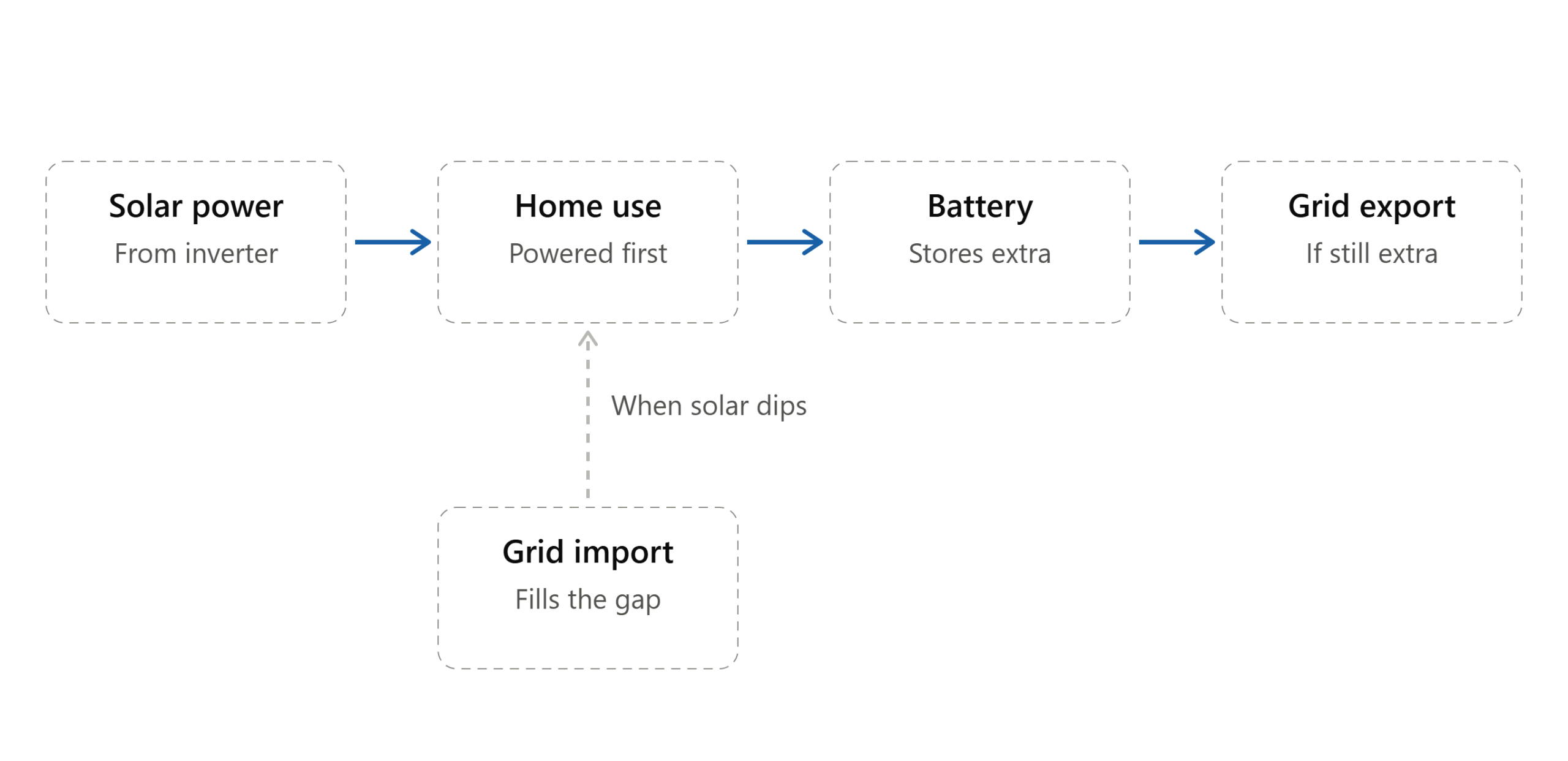
Once AC power leaves the inverter, it flows through your home's main electrical panel — the same breaker box that grid power would use — and from there the system follows a priority order:
1.
Your appliances get first claim. Whatever your home is drawing right now — lights, fridge, HVAC, whatever's running — gets served directly from solar production. This happens instantly and automatically; there's no delay or switching involved.
Your appliances get first claim. Whatever your home is drawing right now — lights, fridge, HVAC, whatever's running — gets served directly from solar production. This happens instantly and automatically; there's no delay or switching involved.
2.
Leftover power charges the battery. If your panels are producing more than the house is using at that moment (common around midday), the surplus routes to the battery pack until it's full.
Leftover power charges the battery. If your panels are producing more than the house is using at that moment (common around midday), the surplus routes to the battery pack until it's full.
3.
Any power beyond that exports to the grid. Once the battery's topped off and the house is satisfied, extra production gets pushed out onto the utility grid. Depending on your utility and country, this either earns you a credit (net metering), gets bought at a wholesale rate, or in some setups isn't compensated at all — worth checking your specific utility's policy.
Any power beyond that exports to the grid. Once the battery's topped off and the house is satisfied, extra production gets pushed out onto the utility grid. Depending on your utility and country, this either earns you a credit (net metering), gets bought at a wholesale rate, or in some setups isn't compensated at all — worth checking your specific utility's policy.
4.
When solar isn't enough, the grid fills in. On a cloudy stretch, or the moment demand spikes past what your panels are making (say, the AC and oven both kick on at once), the shortfall is drawn from the grid — or from the battery first, if you have one and it's charged, before the grid ever gets tapped.
When solar isn't enough, the grid fills in. On a cloudy stretch, or the moment demand spikes past what your panels are making (say, the AC and oven both kick on at once), the shortfall is drawn from the grid — or from the battery first, if you have one and it's charged, before the grid ever gets tapped.
A smart meter at the utility connection point tracks all of this — how much you're importing versus exporting — which is what your utility bill (or credit) is based on.
One nuance: the exact priority order between "charge the battery" and "export to the grid" is actually configurable on most modern systems. Some people set theirs to prioritize battery charging for backup security; others prioritize export if their utility pays well for it.
One nuance: the exact priority order between "charge the battery" and "export to the grid" is actually configurable on most modern systems. Some people set theirs to prioritize battery charging for backup security; others prioritize export if their utility pays well for it.
Interactive diagram of a solar battery pack charging and discharging: lithium ions move between a cathode and an anode across an electrolyte, driven by a charger during charging and released to power a load during discharging. Toggle between charging and discharging to see ion and electron flow reverse.
Here's what's happening inside that battery pack:
Two electrodes, one liquid go-between
A lithium battery has a cathode (typically a lithium metal oxide) on one side and an anode (usually graphite) on the other, separated by an electrolyte — a liquid or gel that lithium ions can swim through, but electrons can't.
A lithium battery has a cathode (typically a lithium metal oxide) on one side and an anode (usually graphite) on the other, separated by an electrolyte — a liquid or gel that lithium ions can swim through, but electrons can't.
Charging pushes ions uphill
When solar power (or grid power) charges the battery, an external charger forces electrons into the anode. That electrical push strips lithium ions off the cathode and drives them across the electrolyte to lodge in the anode's graphite structure — a process called intercalation. This is an energetically "uphill" move, which is exactly why it takes outside power to make it happen.
When solar power (or grid power) charges the battery, an external charger forces electrons into the anode. That electrical push strips lithium ions off the cathode and drives them across the electrolyte to lodge in the anode's graphite structure — a process called intercalation. This is an energetically "uphill" move, which is exactly why it takes outside power to make it happen.
Discharging lets them roll back down
Once you disconnect the charger and connect a load — your house at night — the ions want to return to the lower-energy cathode. As they migrate back across the electrolyte, they force electrons to take the long way around through the external circuit to balance the charge. That electron flow through your inverter and into your home is the actual electricity you're using.
Once you disconnect the charger and connect a load — your house at night — the ions want to return to the lower-energy cathode. As they migrate back across the electrolyte, they force electrons to take the long way around through the external circuit to balance the charge. That electron flow through your inverter and into your home is the actual electricity you're using.
Why it doesn't just self-discharge instantly
The electrolyte and a thin separator film block electrons from taking a shortcut straight through the middle — they can only travel via the external wire. That's what turns "ions wanting to move" into "electricity you can actually use," rather than the battery just short-circuiting itself internally.
The electrolyte and a thin separator film block electrons from taking a shortcut straight through the middle — they can only travel via the external wire. That's what turns "ions wanting to move" into "electricity you can actually use," rather than the battery just short-circuiting itself internally.
Charge cycles and degradation
Each full charge/discharge cycle causes tiny amounts of wear on the electrode structures, which is why batteries are rated in cycle counts (often 3,000–6,000+ for quality solar storage) rather than a fixed calendar lifespan — the toggle above is essentially simulating one of those cycles in miniature.
Each full charge/discharge cycle causes tiny amounts of wear on the electrode structures, which is why batteries are rated in cycle counts (often 3,000–6,000+ for quality solar storage) rather than a fixed calendar lifespan — the toggle above is essentially simulating one of those cycles in miniature.